

Selecting an optimal viscosity testing method challenges coatings laboratories seeking reproducible correlation between bench data and line application. Liquid coatings are complex multi-phase systems where polymer binders, volatile solvents, and suspended pigments interact under mechanical shear. Characterizing these interactions requires an instrument geometry aligned with physical forces encountered during storage, handling, and application.
Coating formulations rarely behave as ideal Newtonian liquids with fixed internal resistance. Single-point benchtop checks frequently fail to capture dynamic thinning, resulting in unexpected sagging, poor atomization, or pigment settling during warehouse storage. Analyzing non-Newtonian flow curves enables technicians to diagnose defect risks before production batches leave the facility.
Hydrodynamic Shear Regimes Across Coating Lifecycles
Formulators categorize fluid mechanics across three operational shear regimes during production, storage, and application. Low-shear zones govern what happens inside containers and on vertical surfaces immediately following wet application. Mid-shear zones dictate pumping and mixing, while high-shear zones dominate brush application, roller spreading, and atomization.
During static storage, gravity can promote sedimentation or phase separation in susceptible formulations. Low-shear rheological measurements and appropriate stability tests can help evaluate these risks. Formulations must maintain adequate internal network structure during this quiescent phase to prevent phase separation and pigment caking inside inventory drums. Without sufficient low-shear yield stress, heavy mineral pigments settle into unmixable cakes.
Dynamic processing environments, conversely, force materials through rapid pumping pipelines, high-speed dispersers, or spray nozzles at shear rates exceeding ten thousand reciprocal seconds. Capturing flow resistance across these extremes requires matching the physical measurement geometry to the target hydrodynamic regime rather than relying on an arbitrary bench setting.
Stormer Consistency Profiling for Packaging and In-Can Stability
ASTM D562 established the paddle-driven Stormer configuration as the historical benchmark for evaluating architectural paints, pasty compounds, and wall coatings. The standardized offset paddle rotates inside a cylindrical container, quantifying the mechanical resistance required to maintain a steady rotational speed through the bulk fluid under mid-shear conditions.
A Stormer-type viscometer measures paint consistency using Krebs units under the applicable test conditions. If an instrument also displays centipoise values, users should follow the manufacturer’s specified measurement and conversion method rather than treating KU and cP as universally interchangeable. This empirical index reliably correlates with operator perception of brush drag, can pouring characteristics, and dipping consistency. It provides batch-release operators with a fast, repeatable qualification metric for architectural packaging lines.
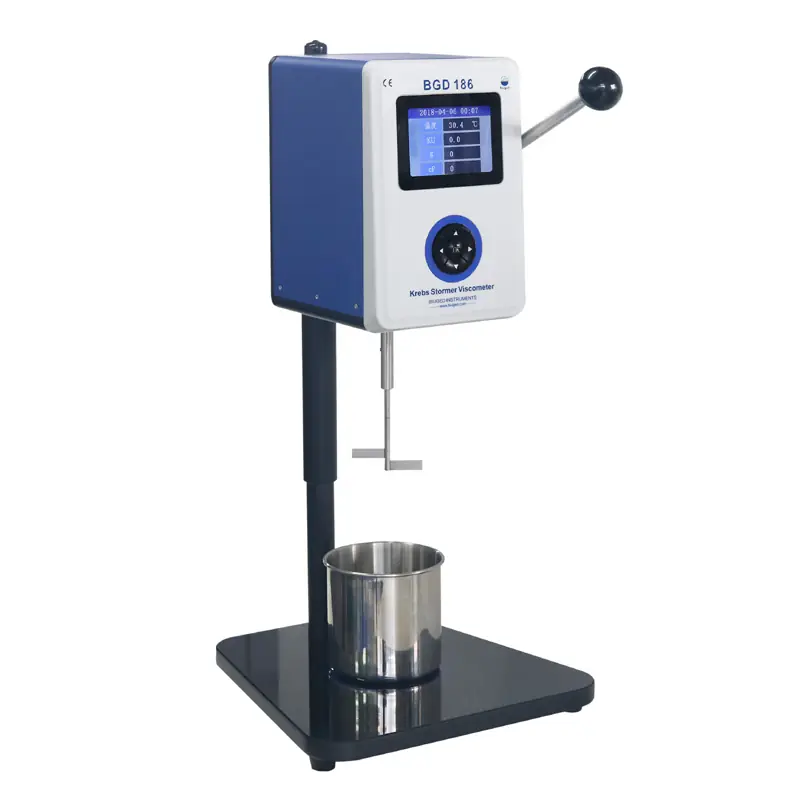
Digital platforms such as the BGD 186 Intelligent Krebs Stormer Viscometer automate this routine, operating at a regulated speed of 200 rpm. Measuring across 40.2 to 141.0 KU and 27 to 5,250 cP, the instrument integrates real-time infrared temperature sensing to eliminate thermal calculation errors during batch release.
High-Shear Cone-and-Plate Geometries for Dynamic Film Transfer
High-velocity application techniques demand testing conditions that mirror the intense mechanical stress generated at atomization nozzles and doctor blades. Low-shear paddle measurements provide zero predictive insight into whether a fast-curing automotive clearcoat will atomize uniformly or form severe orange peel texture across contoured metal body panels.
Cone-and-plate viscometers measure dynamic viscosity under defined high-shear conditions. ISO 2884-1:2024 specifies a procedure for unpigmented coating materials at shear rates between 9,000 and 12,000 s⁻¹. Confirm sample suitability, instrument configuration, and test conditions before applying the method.
Engineers can use cone-and-plate viscometry to characterize coating viscosity at high shear rates and combine the results with application tests to assess film formation and roller spatter behavior. Rapid built-in thermoelectric heating stabilizes the microscopic fluid volume within seconds, enabling immediate data acquisition and high-throughput evaluation during modern industrial paint manufacturing.
Spindle-Based Viscometry for Thixotropic and Leveling Characterization
Benchtop rotational viscometers equipped with standard disc or cylindrical spindles provide multi-speed flexibility under ISO 2555 and ASTM D2196. Changing spindle dimensions and motor velocities allows testing personnel to evaluate non-Newtonian flow over broad, adjustable shear intervals across research and production batches.
Stepped speed gradients clarify whether a sheared film recovers structural integrity fast enough to eliminate curtaining without trapping brush marks. Calculating the ratio between low-speed and high-speed viscosity yields the formulation’s thixotropic breakdown index, guiding rheology additive adjustments for primers, marine coatings, and structural gel coats.
Modern rotational viscometers mitigate operator inconsistency through automated positioning systems, pre-programmed shear cycles, and digital interfaces. Digital touch-screen units like the BGD 155 series incorporate precision stepping motors and linear calibrations, achieving ±1.0% accuracy across polymer solutions, printing inks, and structural adhesives.
Eliminating Thermal and Mechanical Artifacts on the QC Bench
Temperature fluctuations destabilize polymer cohesion, shifting measured viscosity readings by upward of five percent for every single degree of deviation. Reliable rheological validation mandates circulating thermal jackets or integrated platinum resistance probes submerged directly within the active fluid volume to preserve data integrity across ambient seasonal shifts.
Centering and leveling errors generate false mechanical friction, accelerating pivot bearing degradation and producing spurious torque spikes. Utilizing automated electronic leveling sensors guarantees spindle concentricity, ensuring measured resistance reflects true hydrodynamic drag rather than mechanical contact or uneven fluid immersion against sample vessel walls.
Container boundary conditions also impact fluid resistance, particularly during low-viscosity evaluations using large cylindrical rotors. Standardizing beaker dimensions and utilizing matching spindle bracket guards suppresses erratic vortex formation and wall-slippage phenomena, safeguarding reproducibility across comparative multi-facility testing programs and supplier audits.
Standardizing Laboratory Quality with BIUGED INSTRUMENTS
Developing specialized rotational viscometers alongside automated Krebs and high-shear platforms, BIUGED INSTRUMENTS designs equipment conforming strictly to international testing standards. Their precision testing hardware equips coatings formulators, polymer synthesis teams, and commercial analytical laboratories across more than eighty countries.
Decades of engineering refinement allow BIUGED INSTRUMENTS to deliver touch-screen interfaces, magnetic spindle couplings, and certified calibration standards that simplify daily quality control. These rugged systems resist aggressive cleaning solvents, protect internal drive bearings, and generate audit-ready digital reports across multi-shift laboratory operations.
Quality control managers seeking to eliminate batch-to-batch variation should consult BIUGED INSTRUMENTS to evaluate their plant testing protocols. Upgrading to purpose-built viscosity measurement instruments establishes true rheological control, safeguarding product performance from synthesis reactors to customer application lines.

