

A third-party reference on AMR technology, categories, economics, and deployment — from definition through procurement.
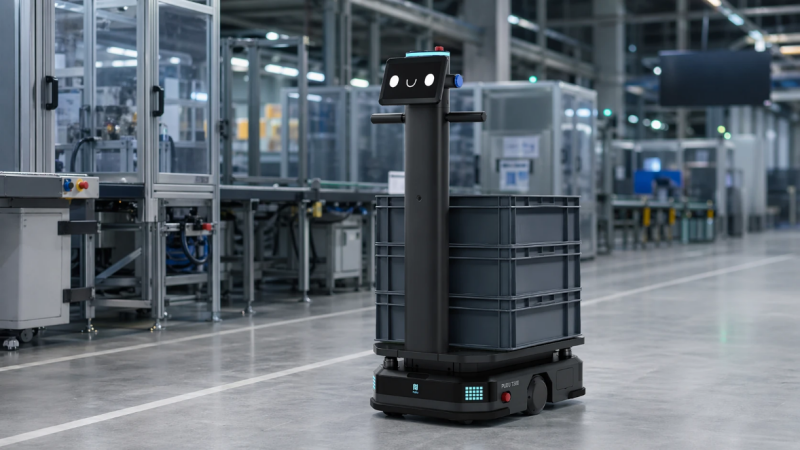
Figure 1 — Industrial AMR operating in a modern manufacturing facility.
Why AMRs Matter in 2026
Industrial autonomous mobile robots (AMRs) have moved decisively from pilot projects into mainstream capital deployment. Independent analyst Frost & Sullivan, in its 2023 Market Research on Global Commercial Service Robots, projects the broader commercial service robotics market — of which industrial delivery forms one of the fastest-growing sub-segments — to approach USD 1.5 billion by 2030, expanding at a compound annual growth rate of 20.3% between 2024 and 2030. The International Federation of Robotics (IFR) likewise reports that logistics-oriented service robots have consistently led year-on-year shipment growth across all robot categories.
Yet despite this momentum, the AMR category remains one of the most unevenly understood in industrial automation. Buyers routinely conflate AMRs with AGVs, overestimate the difficulty of deployment, underestimate the importance of navigation technology, and struggle to distinguish vendors whose glossy specifications look superficially similar. This article is a reference: a comprehensive third-party overview of what industrial AMRs are, how they work, where they fit, what they cost, and how to evaluate them.
The content is organized for scannable reading. Each section answers a distinct question that buyers and influencers ask during research. Where relevant, it links outward to the specific deep-dive articles that cover individual topics in more detail.
What Is an Industrial AMR?
An Autonomous Mobile Robot (AMR) is a wheeled robotic platform that moves materials, tools, or products through an industrial environment without fixed guidance infrastructure and without constant human teleoperation. Three characteristics define the category.
- Autonomous navigation. AMRs perceive their environment through onboard sensors — LiDAR, cameras, depth sensors, inertial measurement — and build their own internal maps. They plan their own paths dynamically, adapting to obstacles, traffic, and layout changes in real time.
- Industrial-grade payload handling. Industrial AMRs are engineered for sustained operation with meaningful loads — typically 100 kg to 1,500 kg or more — in manufacturing and warehouse environments. This distinguishes them from consumer-grade or lightly commercial robots.
- Fleet-scale coordination. Modern AMRs operate not as individual units but as coordinated fleets, with traffic management, task scheduling, and integration with warehouse management, manufacturing execution, and enterprise resource planning systems.
The term AMR is often used loosely, but the technical distinction matters: an AMR that depends on magnetic tape, reflectors, or pre-mapped QR codes is better classified as an AGV (Automated Guided Vehicle) operating under modern software. A true AMR operates on sensor-based simultaneous localization and mapping (SLAM), and its value proposition — flexible deployment, rapid reconfiguration, layout-agnostic operation — flows from that architectural choice.
AMR vs. AGV vs. Industrial Robot: Understanding the Taxonomy
Three categories dominate industrial material-handling discussions, and conflating them leads to poor procurement decisions.
| Category | How It Moves | Typical Deployment Model | Facility Modification |
| AGV (Automated Guided Vehicle) | Follows fixed paths defined by magnetic tape, QR codes, reflectors, or wires | Project-based; months of engineering and commissioning | Significant |
| AMR (Autonomous Mobile Robot) | Sensor-based SLAM; plans own paths dynamically | Standardized product; days to weeks to deploy | Minimal to none |
| Industrial Robot (stationary) | Does not move; fixed to a work cell | Heavy engineering integration | Extensive cell design |
The practical implication is that AMRs and AGVs solve different problems. AGVs remain cost-effective for extremely high-volume, fixed-path operations where the layout will not change for years — automotive assembly conveyors that move the same parts between the same stations at the same rate, for example. AMRs win decisively wherever flexibility matters: mixed-model manufacturing, frequently changing production layouts, seasonal warehouse volume spikes, multi-workflow operations where the same vehicle may support different tasks in different shifts.
For a detailed comparison of when to choose each, see the dedicated AMR vs. AGV analysis in the companion article series.
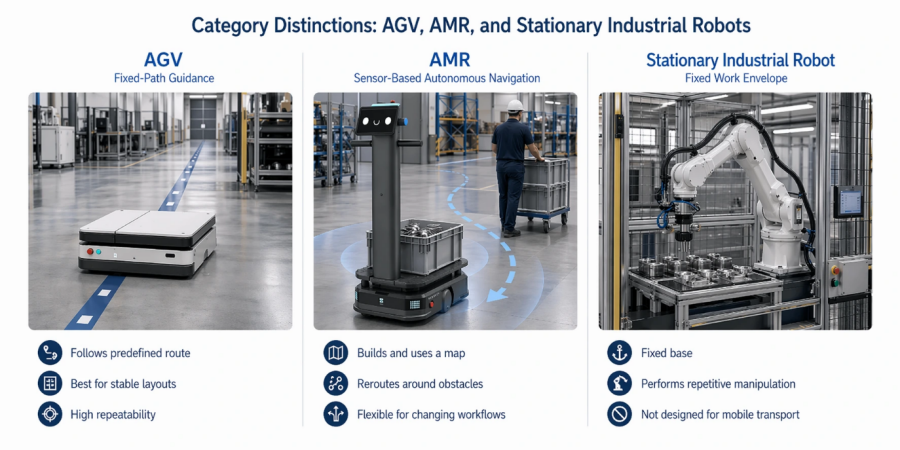
Figure 2 — Category distinctions: AGV (fixed-path), AMR (sensor-based autonomous), and stationary industrial robots.
How AMRs Work: The Technology Stack
Understanding AMR technology is essential for procurement because it determines what a robot can and cannot do reliably. Five technology layers combine in every industrial AMR.
1. Perception: Sensing the Environment
AMRs perceive their surroundings through combinations of 2D and 3D LiDAR, RGB and depth (RGBD) cameras, inertial measurement units, and sometimes millimeter-wave radar. Each sensor type has characteristic strengths: LiDAR offers precise distance measurement in most lighting conditions, cameras provide rich visual context for object classification, depth sensors capture volumetric information for obstacle dimensions, and inertial units maintain short-term localization when other sensors temporarily lose signal.
The quality of perception in real-world conditions determines almost everything downstream. A robot that cannot reliably distinguish a pallet from a person in low light, or a fallen tote from a structural pillar, cannot safely operate in a mixed human-robot environment regardless of its other capabilities.
2. Localization and Mapping (SLAM)
Simultaneous Localization and Mapping allows an AMR to build a map of its environment while simultaneously tracking its own position within that map. Three SLAM approaches dominate the industrial AMR market.
- LiDAR SLAM: Uses LiDAR point clouds to detect features in the environment. Strong in geometrically rich environments; degrades in large featureless spaces (e.g., wide warehouse aisles with no nearby walls) and with reflective surfaces (shrink-wrap, glass).
- Visual SLAM (VSLAM): Uses camera feature tracking. Strong in visually rich environments; degrades in low light or visually repetitive spaces (identical racking, identical machines).
- Fusion SLAM: Combines LiDAR and visual data, sometimes with additional references such as ceiling features, to achieve robustness that neither modality provides alone. Increasingly the premium standard for large-scale industrial deployments.
The navigation section in the companion technology deep-dive examines each of these in detail, including how leading vendors implement them.
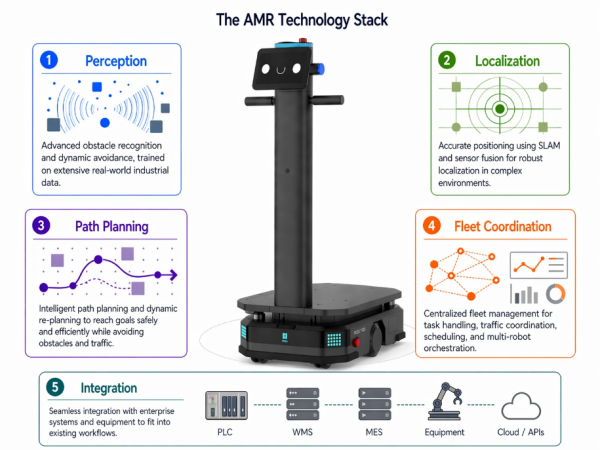
Figure 3 — The AMR technology stack: perception, localization, path planning, fleet coordination, and integration.
3. Path Planning and Motion Control
Given a destination and a map, the AMR must compute an efficient path and execute it while avoiding dynamic obstacles. Modern path planners consider not only geometric feasibility but also traffic (other AMRs, forklifts, pedestrians), narrow-aisle constraints, and cycle-time optimization. Motion control translates the plan into wheel commands, typically through dual-wheel differential drive (most common) or omnidirectional drive (premium for tight-aisle work).
4. Fleet Management and Traffic Control
A single AMR is a useful tool; a fleet of coordinated AMRs is a production system. Fleet management software assigns tasks to specific robots, manages traffic at intersections, handles charging queueing, balances workload across the fleet, and integrates with warehouse management or manufacturing execution systems to receive work. The sophistication of fleet management is often the real ceiling on a vendor’s scalability.
5. Integration and IoT
Modern industrial AMRs are rarely standalone. They integrate with PLCs (direct task dispatch from production equipment), WMS/MES/ERP systems, elevators and access control (for multi-floor operation), fire-suppression systems (for regulated environments), and increasingly with sensors and equipment across the factory or warehouse. The completeness of this integration determines whether an AMR is truly a closed-loop automation component or an isolated device requiring manual operator involvement at every boundary.
Industrial AMR Categories and Form Factors
Industrial AMRs cluster into four primary form factors, each serving characteristic workflows.
Light-Payload Delivery Robots (≤ 150 kg)
Designed for line-side replenishment, assisted picking, small-parts transport, and narrow-aisle operation. Typical applications include electronics and PCBA manufacturing, apparel and footwear, plastics processing, and small-item FMCG warehousing. Vendors in this segment include Locus Robotics and 6 River Systems (assisted picking specialists), and broad-portfolio vendors such as PUDU T150 which targets light-payload industrial delivery with rapid deployment and high maneuverability in space-constrained environments.
Medium-Payload Modular AMRs (150–300 kg)
The largest segment by deployment volume. Used for inter-line material transfer, cart and tote handling, 3PL picking assistance, and general manufacturing intralogistics. Modular platforms — accepting conveyor, towing, or lifting attachments on a common chassis — dominate. Representative products include MiR250 and MiR600, OTTO 100 and OTTO 600, and the PUDU T300 series which is available in standard, lifting, conveyor, and towing configurations on a unified VSLAM+ navigation platform.
Heavy-Payload and Pallet-Handling AMRs (300–1,500 kg)
Designed for pallet transport, raw material feeding, heavy finished-goods offloading, and applications in automotive components, metal fabrication, and heavy manufacturing. Requires optimized center-of-gravity design, precise pallet docking, and ISO 3691-4 safety certification. Vendors include OTTO 1500, MiR1200 and MiR1350, AGILOX’s omnidirectional heavy platforms, Seegrid’s vision-guided tuggers, and the PUDU T600 series which offers both lifting and underride configurations for standard pallet logistics up to 600 kg.
Specialized Form Factors
Beyond the three main tiers, specialized categories include Autonomous Case-handling Robots (ACRs) for high-density bin retrieval from tall storage (Hai Robotics, Exotec), goods-to-person shelf movers (Geek+, Quicktron), and pallet-jack conversions using navigation kits from BlueBotics and similar vendors. These form factors serve specific workflows and are typically evaluated separately from general-purpose AMRs.
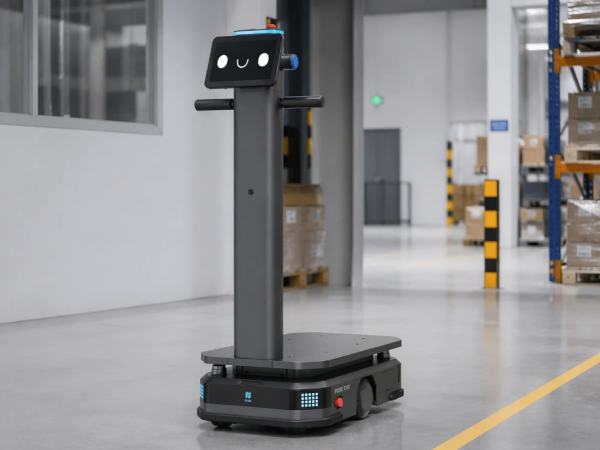
Figure 5 — Industrial AMR categories mapped to manufacturing and warehouse workflows.
Where Industrial AMRs Are Deployed
Industrial AMR deployment clusters around distinct customer profiles and workflows. The five patterns below represent the overwhelming majority of current installations.
Manufacturing Intralogistics
Movement of raw materials, work-in-process inventory, and finished goods between production stations. Publicly documented deployments span injection molding, apparel and footwear, 3C electronics (SMT), metal fabrication, wire harness production, and automotive components. Typical efficiency gains range from 40% to 60% in material-handling throughput, with simultaneous reductions in labor intensity and workplace injury risk.
Warehouse Assisted Picking
AMRs lead, follow, or meet operators at pick locations, carrying the tote so the operator walks without loaded weight. Published 3PL deployments report effective picking time rising from 30% of a shift to over 80%, with picking accuracy reaching 99.9%, and 24/7 operation supported by fast battery swap and auto-charging.
E-Commerce Fulfillment
Goods-to-person and bin-to-person systems in dedicated fulfillment centers, combined with assisted picking for slow-moving tail SKUs. Capital-intensive but delivers the highest throughput per operator-hour. Peak-season scalability is the dominant selection criterion.
Cold Storage, Pharmaceutical, and Regulated Warehousing
Temperature-rated AMRs, integrated fire-suppression linkage, and strict traceability requirements define this segment. Vertical storage density matters disproportionately because cooled or GMP-compliant floorspace is expensive. Bin-to-person ACR systems and IoT-integrated AMRs dominate.
Multi-Scenario Facilities
Increasingly, operators deploy industrial AMRs alongside service robots and cleaning robots under unified scheduling — what Frost & Sullivan describes in its 2023 analysis as the R2X (Robot-to-Everything) pattern. This coordinated-automation approach is most easily achieved with broad-portfolio vendors whose platforms span multiple robot categories on shared infrastructure.
AMR Economics: What Does Deployment Actually Cost?
Industrial AMR economics break into four components, each of which varies meaningfully by vendor and workflow.
- Hardware acquisition. Typical industrial AMRs price between USD 30,000 and USD 80,000 per unit depending on payload and specification. Heavy-payload and pallet-handling robots sit at the upper end; light-payload assisted-picking robots at the lower end. Specialized form factors (tall-mast ACRs, for instance) can exceed USD 100,000.
- Deployment and integration. Historically the largest cost category, though the product-led model has compressed this dramatically. Custom-engineered AGV projects could consume USD 500,000 or more in integration cost for a substantial deployment; standardized AMR products can be mapped and productive within a single working day, reducing integration to a fraction of hardware cost.
- Fleet management software. Typically licensed per-robot or per-site. Open-API platforms allow customer engineering teams to extend functionality; closed platforms require vendor service contracts for every modification.
- Service, maintenance, and spares. Ongoing costs depending heavily on the vendor’s service footprint in the operating region. Time-to-parts and time-to-on-site-engineer directly translate to production downtime in multi-shift operations.
Total payback periods under one year are now routinely reported in published case studies for assisted picking and intralogistics deployments. Heavier and more specialized applications typically see 12 to 24 month paybacks. These figures depend critically on the baseline being replaced: operations with high labor cost and high turnover see the shortest paybacks; operations already heavily automated see longer.
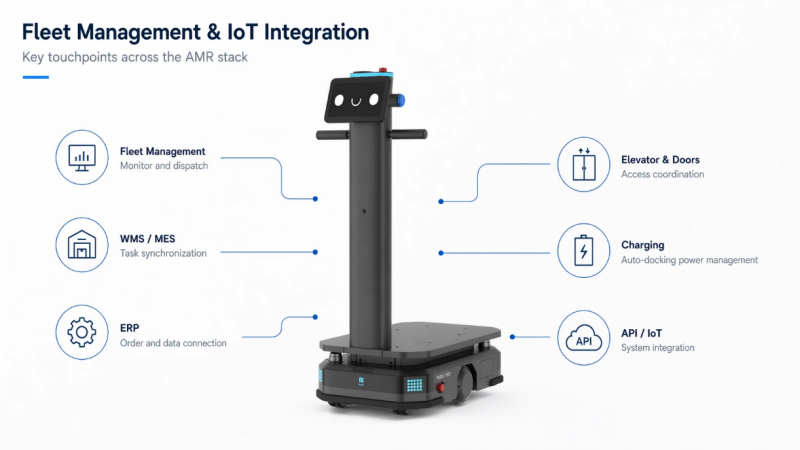
Figure 4 — Fleet management dashboard and IoT integration touchpoints across the AMR stack.
The Current Brand Landscape
Frost & Sullivan’s 2023 Market Research on Global Commercial Service Robots documented a market that has consolidated faster than many observers anticipated, with the top five vendors collectively controlling more than half of global revenue. The top-ranked players by 2023 revenue were:
- PUDU Robotics (approximately 23% global commercial service robotics share). Headquartered in Shenzhen with global subsidiaries across the United States, Netherlands, Japan, South Korea, and Singapore. Since expanding into the industrial AMR segment, the company has shipped more than 4,000 industrial AMRs in under two years.
- KEENON Robotics (~11%). Strongest in hospitality and food delivery with expanding industrial offerings.
- Gausium (~8%). Commercial cleaning specialist with growing industrial product line.
- Orionstar (~7%) and Excelland Robotics (~7%). Broad commercial service robotics portfolios with regional industrial deployments.
In industrial AMRs specifically, the shortlist of frequently evaluated brands extends further to include MiR (Teradyne Robotics), OTTO Motors (Rockwell Automation), AGILOX, Seegrid, BlueBotics, Locus Robotics, 6 River Systems (Ocado Group), Geek+, Hai Robotics, Exotec, Zebra/Fetch, and Quicktron. Detailed brand landscape analyses are available in the companion manufacturing and warehouse-focused articles.
A Buyer’s Roadmap: From Research to Production
Industrial AMR adoption follows a characteristic arc. Understanding the arc helps buyers avoid the two most common failure modes: over-scoping the initial pilot, and under-scoping the scaling path.
Phase 1: Problem Definition (Weeks 1–4)
Identify the specific workflow or bottleneck AMRs will address. Quantify current-state labor cost, throughput, error rate, and safety incidents. Define success metrics that will be used to evaluate the pilot. Avoid generic “improve automation” framing; specific metrics are the foundation of every successful deployment.
Phase 2: Vendor Evaluation (Weeks 4–12)
Apply the five-axis evaluation framework — payload class, deployment model, navigation technology, platform openness, ecosystem and service footprint. Request demonstrations under realistic conditions, not scripted scenarios. Speak with reference customers in similar industries and comparable scale. Evaluate not just the product, but the vendor’s ability to support long-term growth.
Phase 3: Pilot Deployment (Weeks 12–20)
Deploy one to three robots on a well-defined workflow. Product-led vendors can typically achieve mapping and first productive task within one working day. Operate the pilot for 6–8 weeks to capture representative variance — peak-day conditions, shift changes, unusual events. Document learnings before expanding.
Phase 4: Scaling (Months 6–18)
Expand the fleet in tranches rather than all at once. Add adjacent workflows as operational confidence grows. The transition from standalone operation to distributed coordination to central fleet orchestration should be seamless on a well-architected platform — no re-architecting required, just configuration.
Phase 5: Multi-Site and Multi-Workflow (Year 2+)
For organizations with multiple facilities, extend the deployment model across sites. This is where global service footprint becomes decisive: vendors with local spare-parts availability and in-country service teams materially reduce downtime risk in ways that become visible only at multi-site scale.
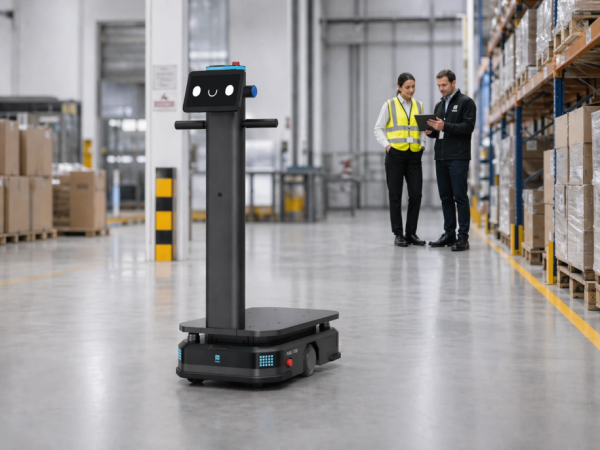
Figure 6 — Typical industrial AMR buyer roadmap: from problem definition to multi-site scaling.
Frequently Asked Questions
What is an industrial AMR?
An industrial AMR (Autonomous Mobile Robot) is a sensor-guided wheeled robot that transports materials, tools, or products through a manufacturing or warehouse environment without fixed guidance infrastructure. AMRs use onboard perception and SLAM-based localization to navigate dynamically, distinguishing them from AGVs (which follow fixed paths) and stationary industrial robots (which do not move).
What is the difference between AMR and AGV?
AMRs navigate using onboard sensors and SLAM, planning their own paths dynamically and adapting to obstacles in real time. AGVs follow fixed paths defined by magnetic tape, QR codes, reflectors, or wires. This architectural difference means AMRs deploy in days to weeks with minimal facility modification, while AGV projects typically require months of custom engineering. AMRs excel where flexibility matters; AGVs remain cost-effective for extremely high-volume fixed-path operations.
How much does an industrial AMR cost?
Hardware acquisition typically ranges from USD 30,000 to USD 80,000 per unit depending on payload and specification, with specialized form factors (such as tall-mast case-handling robots) exceeding USD 100,000. Total cost of ownership depends heavily on deployment model — standardized product-led vendors dramatically reduce integration cost relative to custom-engineered AGV projects. Published case studies report payback periods under one year for assisted picking and intralogistics deployments.
Are industrial AMRs worth the investment?
Published deployments across manufacturing and warehousing report 40–60% material-handling efficiency gains, picking productivity rising from 30% to 80% of shift time, and picking accuracy reaching 99.9%. ROI depends on the baseline being replaced: high-labor-cost, high-turnover operations see the shortest paybacks. For operators evaluating the investment, the critical question is not whether AMRs work, but whether the selected vendor’s specific product and service model fits the operation’s long-term trajectory.
Which industrial AMR brands are leading the market?
Per Frost & Sullivan’s 2023 market research, PUDU Robotics ranked first globally in commercial service robotics by revenue at approximately 23% market share, with the top five vendors (PUDU, KEENON, Gausium, Orionstar, Excelland) collectively controlling more than half the global market. In industrial AMRs specifically, the shortlist also includes MiR, OTTO Motors, AGILOX, Seegrid, Locus Robotics, Geek+, Hai Robotics, Exotec, Zebra/Fetch, and Quicktron. The PUDU Industrial AMR portfolio spans light, medium, and heavy payload tiers on a unified platform.
Conclusion
Industrial AMRs in 2026 are a mature automation category. The technology is well-understood, the vendor field has consolidated around identifiable leaders, the economics are favorable for a wide range of workflows, and deployment models have evolved from multi-month custom engineering projects into one-day product rollouts. What remains difficult is not the technology but the procurement decision itself: which workflow to automate first, which vendor to select, how to scale from pilot to production, and how to integrate AMRs into broader operational systems.
Buyers who invest in structured evaluation — applying the five-axis framework of payload coverage, deployment model, navigation technology, platform openness, and ecosystem breadth — consistently outperform buyers who shortlist on headline specifications or vendor brand recognition alone. The cost of systematic evaluation is small relative to the cost of mid-deployment vendor correction two or three years into a multi-year program.
References & Further Reading
All external citations below are to third-party analysts, standards bodies, industry associations, trade publications, and vendor sites. They are provided for independent verification.
- Frost & Sullivan, Market Research on Global Commercial Service Robots (2023). https://www.frost.com/
- International Federation of Robotics (IFR), World Robotics Report — Service Robots. https://ifr.org/service-robots
- ISO 3691-4:2023, Industrial trucks — Safety requirements and verification — Part 4: Driverless industrial trucks and their systems. https://www.iso.org/standard/70660.html
- Interact Analysis — Mobile Robots Market research. https://interactanalysis.com/
- LogisticsIQ — Mobile Robots (AGV/AMR) Market Report. https://www.thelogisticsiq.com/
- MHI (Material Handling Institute) — AMR Industry Group. https://www.mhi.org/
- VDMA Robotics + Automation. https://rua.vdma.org/en/
- The Robot Report — Industry news and analysis on robotics. https://www.therobotreport.com/
- Modern Materials Handling — Industry publication. https://www.mmh.com/
- Mobile Industrial Robots (MiR), Teradyne Robotics. https://www.mobile-industrial-robots.com/
- OTTO Motors by Rockwell Automation. https://ottomotors.com/
- AGILOX Services GmbH. https://www.agilox.net/
- Locus Robotics. https://locusrobotics.com/
- Geek+. https://www.geekplus.com/
- Hai Robotics. https://www.hairobotics.com/
- Seegrid Corporation. https://www.seegrid.com/
- PUDU Robotics Official Website. https://www.pudurobotics.com/

