

Retail lighting has to do more than make a sales floor bright. A supermarket, fashion store, electronics showroom, and convenience store may occupy similar commercial footprints, yet each presents products, guides shoppers, and manages visual comfort differently.
For contractors, lighting designers, distributors, and retail operators planning a new fit-out or refurbishment, the right LED specification therefore starts with the space and merchandising strategy rather than a single fixture type.
This is where industrial lighting principles can provide a useful reference, particularly when a project involves both functional illumination and retrofit considerations.
The First Step Is to Identify What the Lighting Needs to Accomplish
A useful retail lighting plan separates general illumination from visual emphasis. General lighting establishes a consistent level of visibility across aisles, circulation routes, and working areas. Accent or directional lighting can then draw attention to merchandise, promotional displays, feature walls, or architectural details.
This distinction matters because a fixture that performs well in a warehouse may not create the same visual result in a fashion store. Industrial lighting typically prioritizes broad, functional illumination and practical installation in large areas. Retail environments often require more control over beam direction, glare, color appearance, and fixture placement.
Project teams should begin with a lighting layout. Ceiling height, aisle width, shelf arrangement, existing track position, daylight contribution, and merchandise displays all affect optical distribution. Maintenance access and existing electrical infrastructure should also be reviewed before selecting a replacement system.
Match the Fixture to the Retail Format
Supermarkets and large-format stores often have extensive floor areas where consistent illumination and installation efficiency are important. A linear or trunking-based system can be practical where long continuous runs are needed.
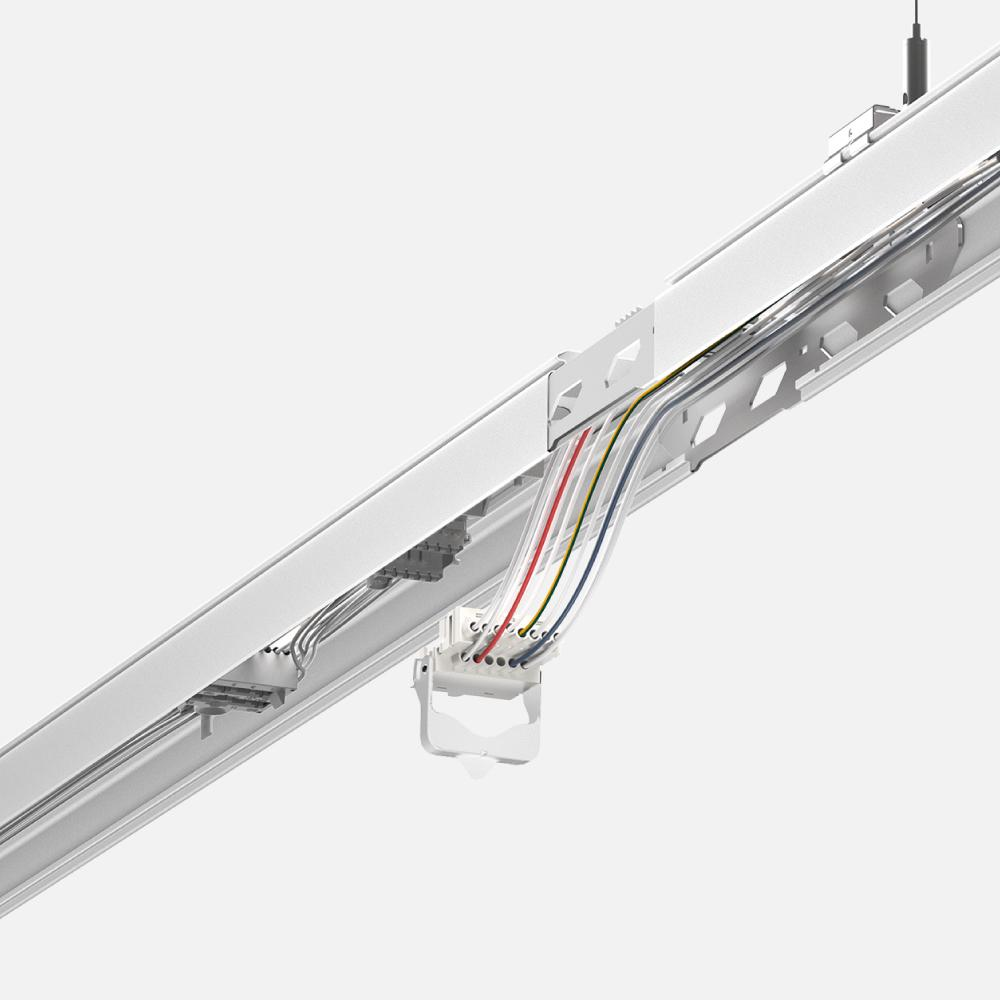
TRIECO’s DREAM PRO, for example, is positioned for large-span industrial and retail spaces and combines a fixed-style trunking system with an integrated design intended for long cascading runs.
The company also offers DREAMFIT and DREAMUNI retrofit modules for different existing trunking conditions. DREAMFIT is designed for situations where the existing trunking circuit can be reused, while DREAMUNI is intended for cases where the original circuit cannot be reused. The manufacturer states that these systems are compatible with more than 30 types of mainstream European trunking rails.
For supermarkets, this type of retrofit approach can be relevant when the objective is to upgrade lighting without treating the entire ceiling infrastructure as a new installation. Compatibility should still be checked against the actual rail, circuit, layout, and project requirements.
Fashion, lifestyle, and specialty stores usually need greater flexibility around merchandise. Track lighting can support changing displays because luminaires can be positioned to respond to different product zones.
TRIECO’s LITA Ultra Slim Linear Track Light System is designed for supermarkets and retail stores, with optical modules compatible with standard multi-brand tracks. Its large-emitting-surface optical design is intended to provide substantial illumination from a compact track luminaire.
Electronics stores, showrooms, and other display-led environments can benefit from a similar modular approach, but the optical selection should reflect the merchandise. Narrower distributions can emphasize a display, while wider distributions can support general areas. The choice depends on mounting height, target surfaces, spacing, and visual hierarchy.
Convenience stores and smaller retail units introduce another consideration: limited ceiling space. A compact batten or linear fixture may provide a cleaner installation where extensive track infrastructure is unnecessary.
TRIECO’s Batten Luminaire is described for retail, industrial, and underground parking applications and supports suspended or surface-mounted installation. Its three-sided prismatic lens and dual optical design are intended to provide soft illumination with reduced glare.
How to Evaluate LED Specifications for a Project
Retail buyers should avoid selecting fixtures by wattage alone. A more complete evaluation should consider luminous output, optical distribution, color temperature, color rendering, glare, mounting method, control compatibility, and the relationship between fixture spacing and target illuminance.
Color rendering matters where shoppers need to judge product appearance. Apparel, cosmetics, food, and home-furnishing displays can be visually sensitive, so the specification should align with the merchandise and the retailer’s design standards. Color temperature also influences the character of the space and should be selected as part of the overall lighting concept.
Glare deserves equal attention. Excessive glare can make displays uncomfortable to view and can affect staff working at counters or service desks. In retail projects, optical design and fixture positioning should therefore be considered together.
Retrofit planning should also account for the existing building. A solution that fits the current trunking, track, or wiring arrangement may reduce disruption compared with a complete replacement, while a modular system can make future maintenance or configuration changes more manageable.
TRIECO states that it provides project support from systematic scheme design through commissioning guidance, which can be relevant for B2B projects involving multiple stakeholders.
Build the Lighting Decision Around the Store, Not the Catalogue
The strongest retail lighting specification is rarely based on one product family across every space. Large supermarkets may prioritize continuous linear illumination, fashion stores may need flexible track-based emphasis, and compact stores may benefit from straightforward surface-mounted solutions.
In each case, the project team should compare optical performance, infrastructure compatibility, installation requirements, maintenance access, and the intended shopping environment.
For contractors and lighting distributors, evaluating the supplier’s broader technical capabilities can also be useful when a retail project involves existing infrastructure or phased refurbishment.
Its manufacturing and project-support capabilities also position it toward professional buyers looking for more than individual fixtures. For contractors and lighting distributors evaluating retail building led lighting solutions, that broader project perspective is useful when upgrades involve existing infrastructure or phased refurbishment.
Ultimately, choosing LED lighting for different retail spaces is a specification exercise rather than a simple product comparison. By starting with the retail format, mapping the lighting tasks, and then matching optics, mounting systems, and retrofit compatibility to the building, project teams can create a lighting scheme that supports both operational requirements and the way merchandise is presented.

