

In critical power distribution systems, electrical equipment must do more than carry current. It needs to manage faults, support safe operation, and maintain continuity when electrical conditions change. For engineers, contractors, distributors, and facility operators, selecting suitable electrical control products requires a clear understanding of how each device performs within the overall distribution system.
Among these devices, the air circuit breaker plays an important role in high current, low voltage distribution. Understanding air circuit breaker working principles, air circuit breaker application requirements, and the characteristics of a low voltage air circuit breaker can help users make more practical equipment decisions.
Why Air Circuit Breakers Matter in Power Distribution
An air circuit breaker, commonly known as an ACB, is designed to protect electrical circuits against conditions such as overload and short circuit. Unlike smaller terminal circuit breakers, ACBs are commonly used at the main distribution level where current ratings and fault levels can be considerably higher.
The main purpose of an ACB is to interrupt abnormal current and isolate the affected section of a system. This helps limit equipment damage and provides a controlled way to manage electrical faults. In critical facilities, the ability to disconnect a faulty circuit quickly can also support safer maintenance and reduce the impact of electrical incidents.
The selection of an ACB should therefore consider rated current, rated voltage, breaking capacity, pole configuration, installation method, and protection requirements rather than focusing on a single specification.
Understanding Air Circuit Breaker Working Principles
The air circuit breaker working process involves detecting an abnormal electrical condition and opening the main contacts to interrupt current. During interruption, the electrical arc generated between contacts must be controlled and extinguished effectively. An ACB uses air as the arc-extinguishing medium, with its internal arc chamber designed to manage this process.
Modern ACBs can incorporate intelligent protection functions that provide more precise control over overload and short-circuit conditions. Depending on the model, additional functions can include undervoltage protection, remote communication, status indication, and electrically operated opening or closing.
These functions become particularly useful in distribution systems where operators need better visibility and control. A well-selected ACB can therefore serve not only as a protective device but also as an important part of the system’s operational management.
Where a Low Voltage Air Circuit Breaker Is Commonly Used
A low voltage air circuit breaker is generally positioned in applications where large current capacity and reliable main circuit protection are required. Typical environments include industrial facilities, power distribution systems, substations, commercial complexes, and other installations with substantial electrical loads.
The air circuit breaker application should match the electrical characteristics of the installation. For example, users need to evaluate the normal operating current as well as the prospective short-circuit current. Installation space and maintenance requirements should also be considered, particularly when choosing between fixed and draw-out configurations.
For systems where equipment replacement or maintenance needs to be performed efficiently, a draw-out ACB can provide practical advantages by allowing the breaker to be withdrawn from its connected position. The appropriate configuration ultimately depends on the distribution architecture and operational requirements.
What to Evaluate When Selecting Electrical Control Products
Electrical control products should be considered as part of a complete electrical protection strategy rather than as isolated components. Compatibility between circuit breakers, protection devices, control equipment, and the distribution system is essential.
Users should first determine the required electrical ratings. Rated current and voltage need to correspond with the system, while breaking capacity should be sufficient for the expected fault conditions. Protection settings are another important consideration because inappropriate settings may result in unnecessary trips or insufficient protection.
Mechanical design and maintenance should also receive attention. Clear operating indicators, accessible terminals, reliable operating mechanisms, and suitable installation configurations can simplify commissioning and routine servicing.
For larger installations, communication capability can also be valuable. Intelligent breakers with remote communication functions can provide additional information for monitoring and system management, depending on the overall control architecture.
MAXGE Electrical Control Solutions for Different Applications
MAXGE provides a range of electrical control products covering MCB, RCCB, RCBO, MCCB, ACB, smart breakers, distribution boxes, industrial devices, and other electrical products. Its product portfolio is designed to address different requirements across low voltage distribution and electrical protection applications.
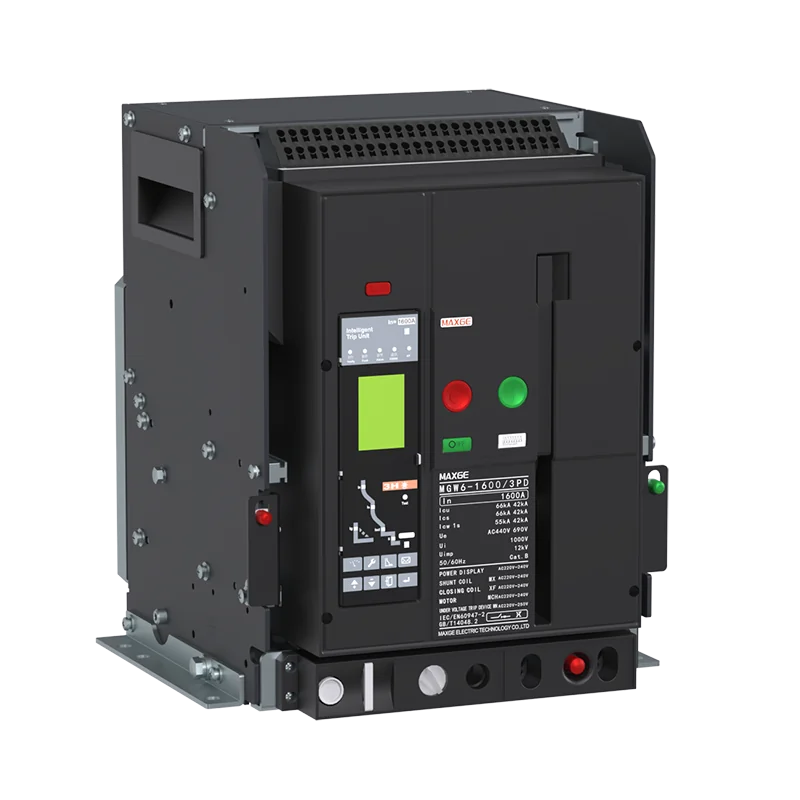
For ACB applications, the MGW6 series covers rated operational currents from 200A to 7500A, with maximum rated operational voltage up to 690V and an ultimate short-circuit breaking capacity of up to 150kA, depending on the model. The series is available in fixed and draw-out configurations and incorporates intelligent protection functions and remote communication capability.
These specifications make the series suitable for different main distribution requirements where high current capacity, protection functions, and operational flexibility are important considerations.
Making a Practical Selection for Your System
Choosing electrical control products should begin with the actual operating conditions of the installation. For systems using an air circuit breaker, reviewing load requirements, fault levels, electrical ratings, protection functions, installation configuration, environmental conditions, maintenance expectations, and communication requirements can provide a more complete basis for product selection. Technical documentation should then be checked against the required electrical and mechanical specifications to confirm compatibility with the distribution system. MAXGE provides a range of low-voltage protection and control products, including ACB solutions for applicable power distribution scenarios, supported by R&D capabilities, manufacturing bases in Deqing and Wuhu, and testing resources including CNAS-related laboratory capabilities and international certifications. Its product portfolio also extends to applications such as PV, renewable energy, energy storage, and EV charging. For ACB specifications, product configuration, or application-related questions, you can contact MAXGE through its official website to discuss your project requirements.

