

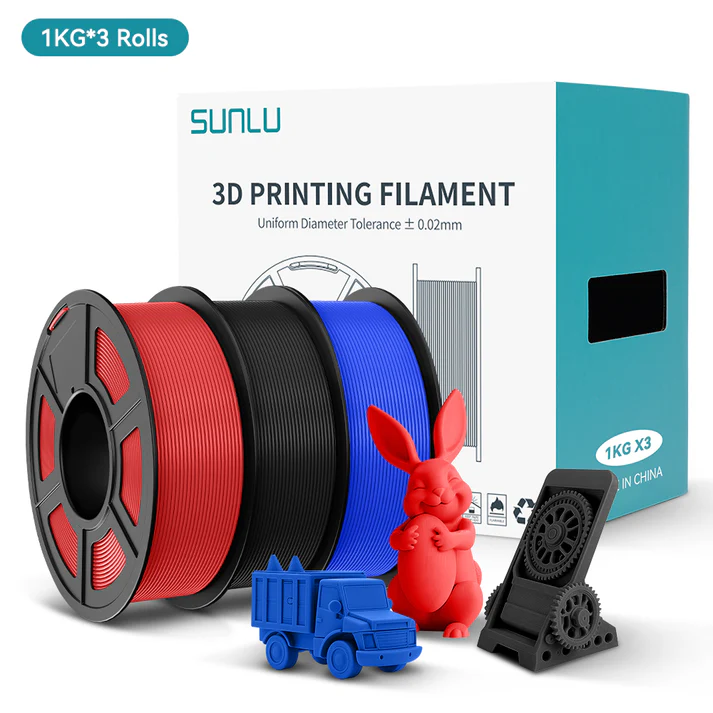
Every 3D printing project requires a unique blend of strength, flexibility, and heat tolerance. Picking the wrong polymer often leads to failed prints, warped corners, or structural weakness.
Navigating choices between PLA, PETG, and ABS becomes straightforward once you match your printer setup with material properties. Leading brands like SUNLU engineer reliable spools that deliver smooth extrusion across common systems.
This comparison breaks down core material characteristics so you can choose the ideal spool for your next manufacturing job.
- Quick Decision Framework for Makers and Engineers
- Go with PLA: Select standard PLA filamentswhen your primary goals are effortless setup, crisp visual details, and low-temperature printing without an enclosure.
- Go with PETG: Choose versatile PETG when you require impact resistance, outdoor weather durability, and chemical protection for daily functional components.
- Go with ABS: Opt for technical ABS when parts must endure high ambient temperatures, heavy physical friction, and rigorous mechanical loads inside enclosed printers.
- Deep Dive into PLA Filament Capabilities
Polylactic acid remains one of the most widely used materials for desktop FDM 3D printing. Because it requires minimal bed heating and low extrusion temperatures, PLA filament is generally easy to print on many desktop FDM systems when the printer is configured appropriately.
When printing intricate display models, using a tuned PLA filament 3D printer environment prevents thermal warping and ugly surface stringing. Strict manufacturing guarantees consistent diameter tolerances across every meter.
For creators seeking vibrant aesthetics, SUNLU PLA filaments offer bright pigments and uniform layer blending. PLA’s relatively low processing temperature can simplify printing, while heat-creep control still depends on the hotend design and cooling setup.
Whether producing quick visual prototypes or complex geometric art, high-quality PLA filament options provide an easy, dependable starting point for every maker.
- Upgrading to Enhanced PLA Formulations
While basic biopolymers excel at visual detail, standard formulas can shatter under heavy physical impact. Material engineers solve this by adding impact modifiers to standard resin bases.
Upgraded options like SUNLU PLA+ deliver significantly higher flexural strength than standard options. Running these modified PLA filament 3D spools creates shock-absorbing components that withstand accidental drops.
These enhanced PLA filaments easily accommodate fast printing speeds on modern high-speed motion hardware. Strong layer fusion remains stable even while printing at rapid volumetric flow rates.
Utilizing modified PLA filament spools gives you structural resilience for everyday mechanical components while preserving simple bed adhesion and low warping.
- Understanding PETG: The Tough Middle Ground
Polyethylene terephthalate glycol serves as the perfect compromise between user-friendly biopolymers and industrial resins. It blends high tensile strength with remarkable flexibility and impact absorbing power.
Unlike basic PLA filaments, PETG naturally resists moisture, UV radiation, and mild solvents. This makes it the preferred selection for custom outdoor brackets, water-tight containers, and mechanical adapters.
Printing PETG requires hotend temperatures near 240°C to 260°C alongside a heated build plate. Consistent spool winding can reduce the risk of tangling and support more reliable filament feeding during long print runs.
Although PETG demands precise retraction tuning to control fine stringing, its structural resilience offers significant advantages over standard PLA filament choices for functional applications.
- Analyzing ABS: Industrial Heat and Impact Strength
Acrylonitrile butadiene styrene remains the golden standard for structural components exposed to heat. For example, SUNLU ABS-FR lists a heat deflection temperature (HDT) of 84°C, which can be used as one reference when evaluating temperature-sensitive applications.
However, printing ABS introduces thermal shrinkage during the cooling process. For example, SUNLU ABS-FR lists a heat deflection temperature (HDT) of 84°C, which can be used as one reference when evaluating temperature-sensitive applications.
When functional prototypes demand heat resistance and post-processing flexibility, SUNLU ABS delivers consistent material density. The surface easily accepts acetone vapor smoothing for a polished finish.
While requiring tighter environment control than standard PLA filaments, ABS remains one option for functional parts such as automotive prototypes, motor mounts, and protective housings when its thermal and mechanical properties meet the application requirements.
- Dimensional Precision and Spool Quality Control
Even the best resin formula fails if material diameter fluctuates wildly along the spool length. Inconsistent thickness alters volumetric flow, causing severe clogs or under-extrusion gaps.
Selected SUNLU filament products specify a diameter tolerance of ±0.02 mm, supporting more consistent material feeding Utilizing high-precision SUNLU PLA filament can support more consistent flow through standard hotend nozzles.
Furthermore, orderly spool winding prevents dangerous crossing knots during unattended overnight printing. Neat spool winding can reduce tangling and help maintain consistent filament feeding.
Selecting carefully manufactured PLA filaments minimizes material waste, protects delicate hardware, and ensures professional visual consistency across every completed model.
- Optimizing Print Temperature and Cooling Settings
Achieving clean layer bonding requires matching hotend temperatures and fan speeds to your specific polymer choice. Correct thermal management prevents stringing, corner lifting, and layer separation.
Standard PLA generally benefits from active part cooling, with fan speed adjusted according to the filament, printer, and model geometry. Maximum airflow sets fine details quickly, preserving sharp overhangs and complex bridges without sagging.
In contrast, materials like PETG and ABS require reduced fan speeds to maintain strong thermal layer bonding. Reducing or disabling part cooling during the initial layers can help improve bed adhesion, depending on the material and printer setup.
Storing your spools in dry sealed boxes keeps moisture away, maintaining original polymer performance over extended periods.
Strategic Summary for Project Material Selection
Selecting between thermoplastics requires evaluating physical strength, heat deflection, and operational convenience. Balancing these factors guarantees successful additive outcomes for every project.
Using precisely calibrated spools prevents unexpected bed separation, nozzle clogging, and surface defects. Consistently manufactured products from SUNLU offer strict tolerance control and pure resin compositions.
Whether crafting flexible gaskets, durable tool housings, or high-detail visual models, choosing verified thermoplastics maximizes hardware efficiency and part quality.

